By the Rishta Team · Published 11 October 2026 · 11 min read
A couple sits with their families at the Nikah ceremony. The Nikah Registrar places a form in front of them: columns, Urdu and English text, blank spaces waiting for signatures. Most people in that room have never read this document before. Many sign it the same way they'd sign a delivery receipt, quickly, trusting that someone else has already checked it.
The Nikah Nama is not paperwork to get through. It's a legal marriage contract, and several of its columns record rights that matter for the rest of the marriage. This guide explains what the document actually says, in plain language, based on the original law rather than guesswork.
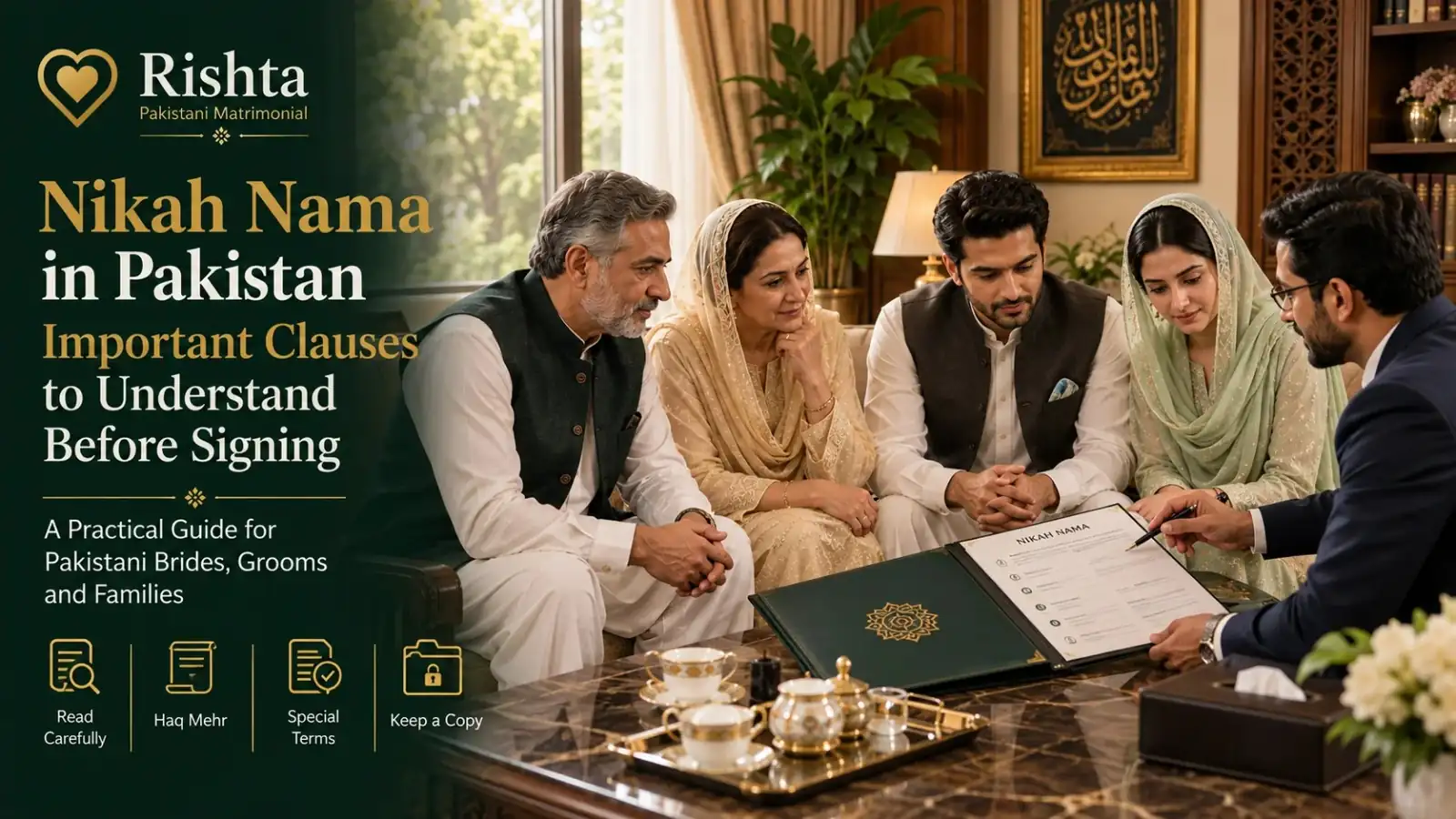
Table of Contents
- 1. What Is a Nikah Nama in Pakistan?
- 2. Why Should You Read the Nikah Nama Before Signing?
- 3. Main Parts of the Nikah Nama Explained
- 4. What Should a Bride and Groom Check Before Signing?
- 5. What Questions Can You Ask the Nikah Registrar?
- 6. Common Mistakes to Avoid When Reviewing a Nikah Nama
- 7. What Happens After the Nikah Nama Is Completed?
- 8. Does Every Nikah Nama Follow Exactly the Same Process Across Pakistan?
- 9. Frequently Asked Questions
- 10. Final Thoughts
What Is a Nikah Nama in Pakistan?
Direct answer: The Nikah Nama is the official marriage contract prescribed under Pakistan's Muslim Family Laws Ordinance, 1961. It records the identities of the bride and groom, the terms of haq mehr (dower), any special conditions agreed between them, and whether the right of divorce has been delegated. Its registration with a licensed Nikah Registrar is a legal requirement, not an optional formality.
Under Section 5 of the Ordinance, every Muslim marriage must be registered, and the Union Council licenses specific individuals as Nikah Registrars for this purpose, one per Ward. If someone other than the licensed Registrar solemnizes the marriage, that person is legally required to report it to the Registrar so it can still be registered. The exact form, the registers Registrars must keep, and how copies are supplied to both parties are all set out in rules made under the Ordinance, not left to informal practice.
Why Should You Read the Nikah Nama Before Signing?
Direct answer: You should read the Nikah Nama before signing because several of its columns, particularly haq mehr, special conditions, and the divorce-related fields, record terms that can affect your rights for the rest of the marriage, and a blank or incorrectly filled column does not automatically protect you the way it might seem to.
This isn't about distrust. In parts of Punjab specifically, the law now requires the Nikah Registrar to read every column aloud to both the bride and groom and fill it in according to their actual answers. A Registrar who skips this step is liable to imprisonment and a fine.
That requirement exists precisely because, for decades, columns were routinely filled in or left blank without either party being asked. Reading the document yourself, rather than relying entirely on the Registrar, remains the simplest way to make sure what's written reflects what was actually agreed.
Main Parts of the Nikah Nama Explained
The prescribed form (known as Form II under the 1961 Rules) has 25 numbered columns. They aren't random. They group into a few practical categories.
Names, Ages, and Place of Marriage
Columns 1 through 6 record the Ward, Tehsil, and District where the marriage took place, the bridegroom's name, father's name, residence, and age, and the same details for the bride, including whether she is recorded as a maiden, widow, or divorcee. Check these against CNIC details and other official records. A misspelled name or wrong age in the register can cause real problems later when the document is needed for NADRA records, visas, or inheritance matters.
Vakils and Witnesses
Columns 7 through 11 record whether either party appointed a vakil (representative) to act on their behalf, and the witnesses to both the vakil's appointment and the marriage itself. Witnesses aren't a symbolic detail. Their names and details are part of the legal record of the marriage.
Haq Mehr (Dower)
Columns 13 through 16 cover haq mehr: the total amount, how much is mu'ajjal (prompt, payable on demand) versus mu'wajjal (deferred, payable later, typically on divorce or death), how much was actually paid at the time of marriage, and whether any property was given in place of cash. This split matters more than the total figure.
Under Section 10 of the Ordinance, if the Nikah Nama doesn't specify how the dower is to be paid, the entire amount is treated as payable on demand. In other words, leaving this column vague doesn't default in the husband's favour. It defaults to the wife being able to claim the full amount immediately. Neither Pakistani law nor this article recommends a specific mehr amount; that figure is a matter for the two families to agree.
Special Conditions
Column 17 is where the bride and groom can record any additional, lawful conditions they've agreed to, for example, around continuing education, employment, or place of residence. This is the column most often left blank in practice, simply because couples don't think to use it or aren't told it exists. If something was discussed and agreed between the families, writing it here is how it becomes part of the actual contract rather than an informal understanding that's hard to prove later. Whether a specific worded condition is enforceable can depend on how it's phrased and the facts of the case. This is exactly the kind of clause worth showing to a family-law professional before relying on it.
Delegated Right of Divorce (Talaq-e-Tafweez)
Column 18 records whether the husband has delegated the power of divorce to the wife, and under what conditions. This is a real legal mechanism under Section 8 of the Ordinance, not a symbolic entry. Where this right has been delegated and the wife wishes to exercise it, the same notice procedure that applies to a husband's talaq applies to her as well. Column 19, separately, records whether the husband's own right of divorce has been restricted in any way.
These are two distinct fields, often confused with each other even on competing explainers: column 18 is about a right given to the wife, column 19 is about a right taken away from the husband. Because how this clause is worded affects how it operates, couples who want to understand its specific effect should ask the Registrar to explain it in plain terms, and consult a lawyer if the answer isn't fully clear.
Other Fields
Column 20 records any separate document drawn up about dower or maintenance. Columns 21 and 22 apply only if the groom has an existing wife — recording whether the Arbitration Council's permission for another marriage was obtained, since marrying again without it carries legal consequences under Section 6. Columns 23 to 25 record who solemnized the marriage, the registration date, and the fee paid.
What Should a Bride and Groom Check Before Signing?
- Read every column before signing. Don't rely on someone else having checked it
- Confirm your name, father's name, age, and marital status match your CNIC
- Confirm the haq mehr amount and the prompt/deferred split actually reflect what was agreed
- If anything was discussed and agreed beyond the standard terms, make sure it's written in the special conditions column, not left as a verbal understanding
- Ask about the delegated right of divorce and the divorce-restriction columns if you don't understand what they mean for your situation
- Don't accept a blank column without asking why it's blank
- Confirm how and when you'll receive your copy of the registered document
- If a clause affects a major financial or personal decision, have it reviewed by a qualified family-law professional before you sign
What Questions Can You Ask the Nikah Registrar?
- Can you explain this column in plain language before I sign?
- Is this column required, or optional in our situation?
- Has the haq mehr been recorded exactly as agreed, including the prompt and deferred amounts?
- How have our special conditions been worded in column 17?
- What does the delegated right of divorce entry mean in practice?
- When and how will each of us receive our copy of the Nikah Nama?
- Who can I ask if I need to understand a legal term better?
A Registrar can explain the document and how it's filled in. For a clause's broader legal effect in your specific circumstances, independent legal advice is the more reliable source.
Common Mistakes to Avoid When Reviewing a Nikah Nama
- Signing without reading, because everyone else in the room seems satisfied
- Leaving the special conditions column blank by default, rather than asking whether anything should be recorded there
- Not checking that names, ages, and other personal details are entered correctly
- Assuming a verbal family agreement is automatically reflected in the written document
- Treating the haq mehr split (prompt vs deferred) as a minor detail rather than the specific financial term it is
- Relying on unverified advice from social media instead of the Ordinance itself or a qualified lawyer
- Assuming every Union Council across Pakistan follows identical administrative steps
What Happens After the Nikah Nama Is Completed?
Once the Nikah Registrar fills in the form, it's signed by the bride, groom, their vakils (if any), the witnesses, and the Registrar, who then seals it. Under the Rules, the Registrar keeps the original in the official register, while the bride and groom are each entitled to their own copy.
The record is ultimately preserved by the Union Council, and any person can later inspect it or request a certified copy on payment of the applicable fee. Specific procedures, fees, and current timelines can vary by Union Council, so confirm these details directly with the relevant office rather than assuming a fixed national process.
Does Every Nikah Nama Follow Exactly the Same Process Across Pakistan?
Direct answer: No. The core form and the underlying legal framework come from the Muslim Family Laws Ordinance, 1961 and apply nationally, but provinces have made their own administrative and procedural amendments since then, so some requirements differ by province.
One clear example: in Punjab, an amendment to Section 5 now makes it a specific legal requirement for the Nikah Registrar to read out every column to both parties and record their actual answers, with defined penalties for failing to do so.
This isn't necessarily worded identically in every province. Because of this, the safest approach is to treat the 25-column structure described above as the standard national framework, while confirming any province-specific requirement with your local Union Council or a family-law professional.